Quantitative ML Research Platform
A full-stack research environment for constructing financial datasets, running reproducible statistical studies, engineering features, evaluating event-sampling methods, training predictive models, and validating research decisions before live deployment.
From market data to model-ready datasets
A reproducible research workflow for testing dataset construction, sampling methodology, stationarity, structural events, and feature behavior before modeling.
Public demo of dataset research, event studies, feature engineering, and AI-assisted analysis. Proprietary parameter values and research conclusions are intentionally redacted.
Explore source data, compare alternative sampling approaches, and evaluate stability, dependence, volatility, and distribution behavior.
Evaluate multiple event-detection approaches using controlled comparisons, overlap analysis, and stability diagnostics.
Combine validated statistical, technical, and event-derived features into reproducible datasets with lineage and completeness diagnostics.
Generate and persist structured research summaries from completed studies, with saved analysis history and reusable experiment context.
From representation learning to out-of-sample validation
A complete modeling workflow for configuring experiments, training transformer representations, diagnosing model behavior, and evaluating performance out of sample.
Portfolio demo run — metrics shown are from a non production experiment created specifically to demonstrate the research workflow.
Research infrastructure built for reproducibility
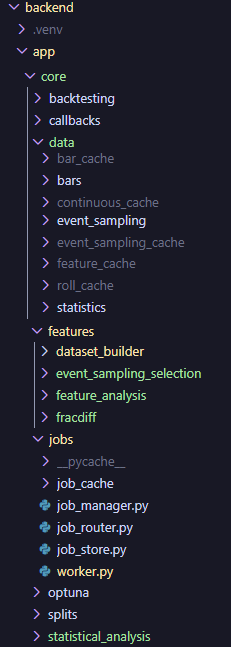
The platform persists data, experiments, and intermediate artifacts so research can be reopened, compared, and reproduced instead of existing only inside one off notebooks.
Dedicated cache layers persist bar construction, continuous-series data, event studies, feature datasets, and downstream research artifacts.
Long-running studies and dataset builds execute outside the request lifecycle while job state and completed results remain available to the UI.
Configurations, metadata, study history, and artifact identities are retained so downstream datasets can be traced back to their research inputs.
Python research services are exposed through API-backed application workflows rather than isolated notebooks, with containerized supporting services.